Log Cabin Quilt Layouts: 10 Ways to Arrange Your Blocks
The log cabin is one of the oldest and most loved quilt blocks, and much of its charm comes from how it is arranged. The same blocks can make diamonds, zigzags, stripes or bold stars, depending only on how you turn them. This guide walks through the classic log cabin quilt layouts, a few modern ideas, and how to plan your arrangement before you sew a single row.
How the log cabin block creates its patterns
A log cabin block starts with a center square, traditionally red for the hearth of the cabin. Strips, or “logs,” are added around it in rounds. In the classic version, one half of the block is made from light fabrics and the other half from dark fabrics, split along the diagonal.
That diagonal split is what makes every layout possible. When you place blocks next to each other, the light and dark halves join up across block edges to form larger shapes. Turn a block a quarter turn and the shape changes. Every layout below uses the same block; only the rotation changes.
Traditional log cabin quilt layouts
Barn Raising
Barn Raising arranges the blocks so the light and dark halves form concentric diamonds radiating out from the center of the quilt. It is the most dramatic of the traditional layouts and works best on a square quilt with an even number of blocks in each row, such as 6 x 6 or 8 x 8.
Light and Dark (Sunshine and Shadows)
Groups of four blocks are turned so their dark halves meet in the middle, forming dark diamonds surrounded by light ones. Across the quilt, this creates a checkerboard of diamonds. It is an easy layout for beginners because it repeats in simple four-block units.
Straight Furrows
Every block is turned the same way along a diagonal, so the light and dark halves line up into wide diagonal stripes running corner to corner. The look is calm and graphic, and it is very forgiving if your blocks vary slightly in color.
Streak of Lightning (Zigzag)
Rows of blocks are turned to create bold zigzags that run across or down the quilt. It suits modern color palettes as well as traditional scrappy fabrics, and it reads clearly even from across a room.
Pinwheel and Star
Turning groups of four blocks so the dark halves spin around a center point creates pinwheels. Change the rotation and the dark halves form a star instead. These layouts look complex but are made from the same simple block.
Modern log cabin quilt layouts
- Wonky log cabin: logs are cut at slight angles, giving each block an improvised, hand-drawn feel.
- Off-center log cabin: the center square sits in a corner, so the block reads as a stepped gradient rather than a target.
- Courthouse Steps: logs are added to opposite sides in pairs, creating a symmetrical bow-tie look.
- Low-volume log cabin: mostly white and cream fabrics with one accent color, for a soft modern quilt.
- Negative space layouts: a few log cabin blocks scattered across a large solid background.
Log cabin layouts at a glance
| Layout | What it looks like | Skill level | Works best with |
|---|---|---|---|
| Barn Raising | Concentric diamonds from the center | Intermediate | Square quilts, even block counts |
| Light and Dark | Checkerboard of diamonds | Beginner | Any size, four-block repeats |
| Straight Furrows | Diagonal stripes | Beginner | Scrappy fabrics |
| Streak of Lightning | Zigzags across the quilt | Beginner | Bold, high-contrast colors |
| Pinwheel or Star | Spinning shapes or stars | Intermediate | Clear light and dark contrast |
How to plan your log cabin layout on a design wall
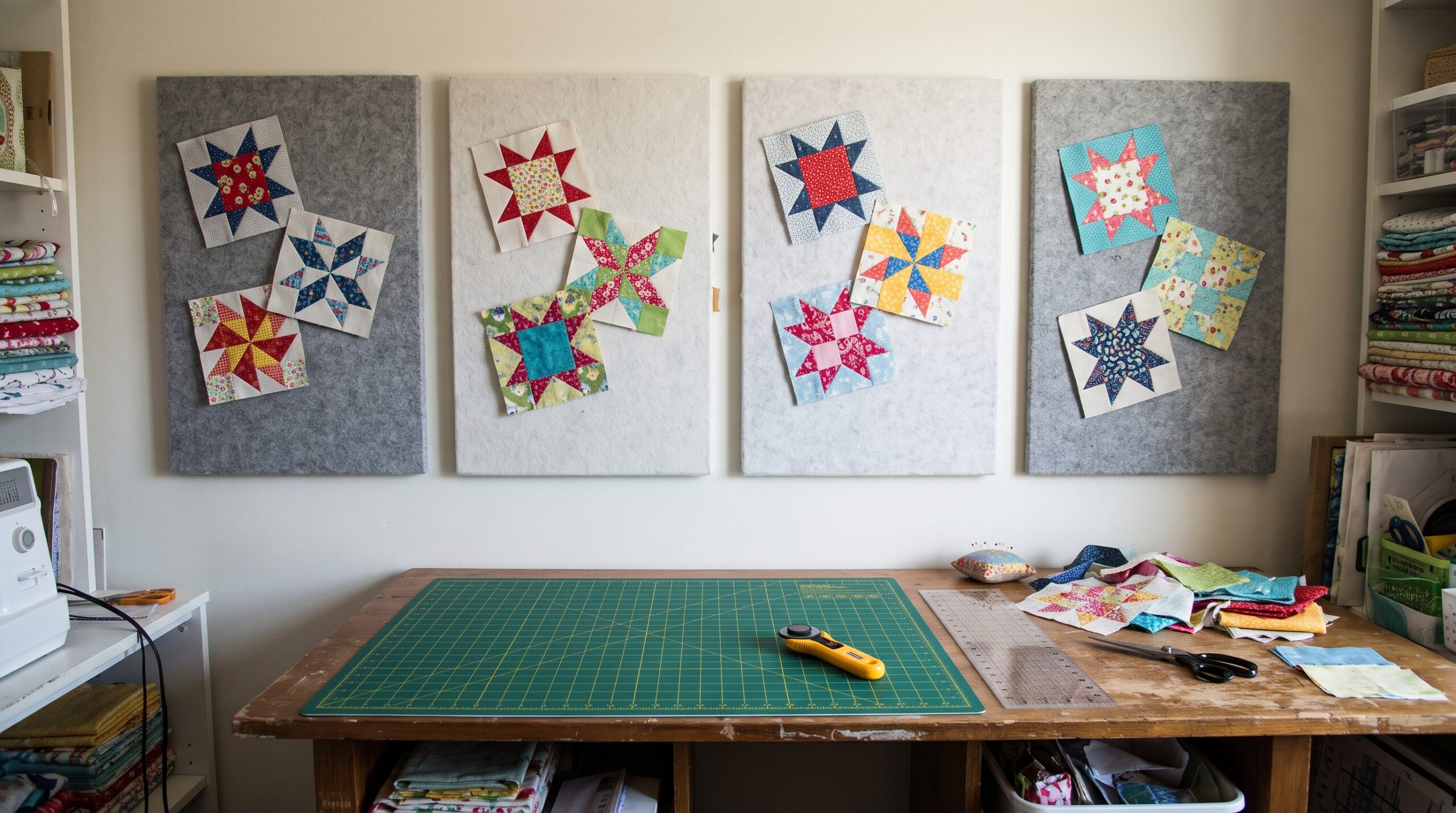
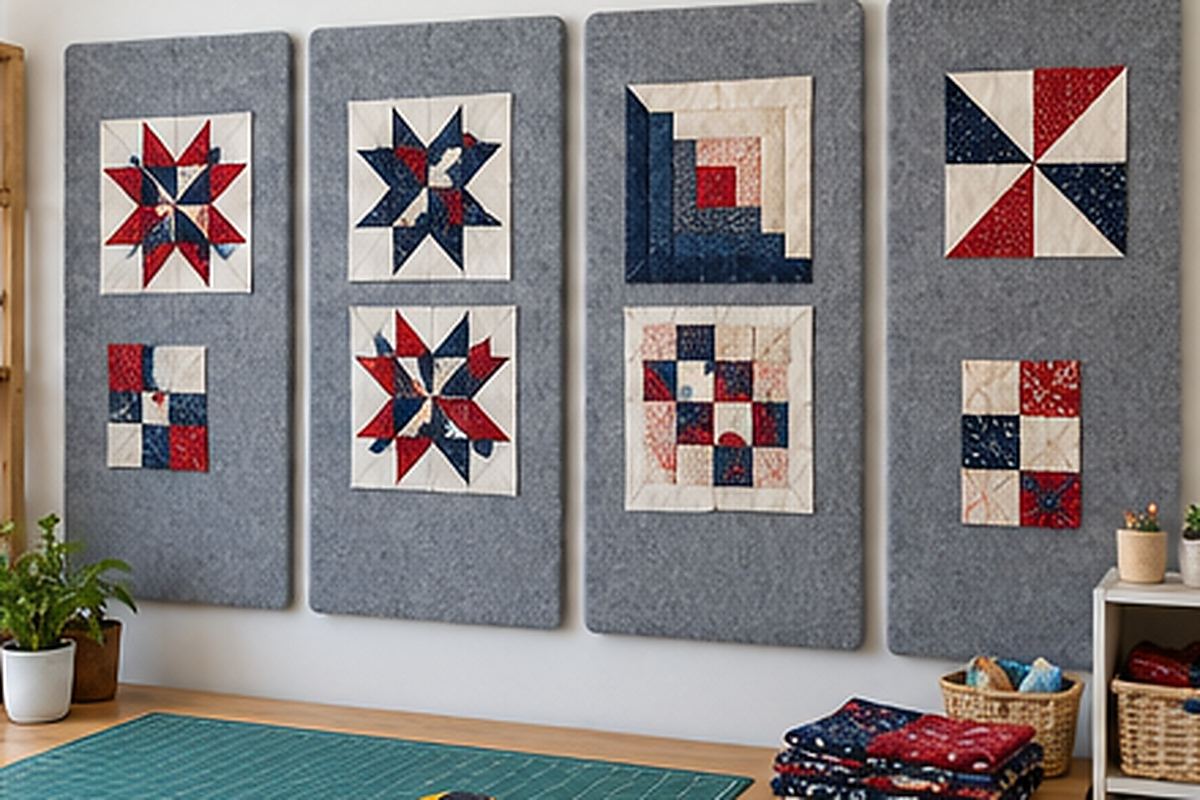
Because one quarter turn changes the whole pattern, log cabin quilts are much easier to plan standing up than on the floor. A quilt design wall lets you try several layouts in minutes. If you like to sketch first, see our guide to quilt design software and apps.
- Make all your blocks first, or at least enough for one quarter of the quilt.
- Put them on the wall in your planned layout. Grid lines help keep rows straight and blocks evenly spaced.
- Step back at least 6 feet. Look at whether the diamonds, stripes or zigzags read clearly.
- Take a photo and view it in black and white. This shows whether your light and dark fabrics have enough contrast for the pattern to show.
- Try a second layout. Rotate the same blocks into another arrangement and photograph it, then compare the two.
- Take blocks down row by row and label them, so they go into the quilt in the right order.
If you need space for a big layout, our large quilt design wall comes in 106″ x 60″, and our quilt design wall tiles are handy for laying out a few blocks at a time. Not sure which to choose? Read our guide to the best quilt design wall, or make your own. For other ways to set blocks, see our overview of quilt layouts.
Tips for a crisp log cabin layout
- Keep strong contrast between the light and dark halves. Medium tones blur the pattern.
- Square up every block to the same size before laying them out, so points and seams line up.
- Use an even number of blocks in each direction for Barn Raising and Pinwheel layouts.
- Keep the center squares consistent in color if you want them to read as a deliberate accent.
- Plan borders last. Audition border fabrics on the wall once the center is arranged.
Frequently asked questions
What is the most popular log cabin quilt layout?
Barn Raising is the best known, with its concentric diamonds. Light and Dark is the most common choice for beginners because it repeats in simple four-block groups.
How many blocks do I need for a log cabin quilt?
It depends on block size and quilt size. With 12-inch finished blocks, a throw quilt of about 60″ x 72″ needs 30 blocks (5 x 6). For Barn Raising, choose an even number in each direction, such as 6 x 6.
Can you change a log cabin layout after the blocks are made?
Yes. Every traditional layout uses the same block, so you can try several arrangements on a design wall and choose the one you like before sewing the rows together.
What is the difference between log cabin and Courthouse Steps?
In a log cabin block, logs spiral around the center one side at a time. In Courthouse Steps, logs are added to opposite sides in pairs, which makes a symmetrical block.
Why is the center of a log cabin block red?
Traditionally the red center represents the hearth, the warm heart of the cabin. Today many quilters use any accent color for the center.
Tags